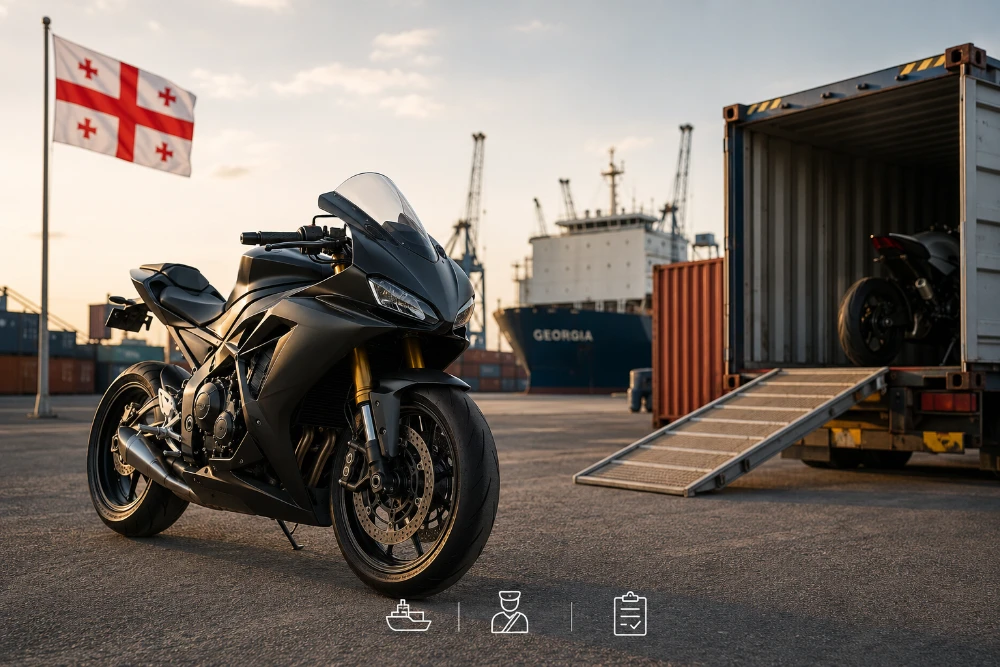
Importing a Motorcycle to Georgia – A Complete Guide from Import to Registration
Buying a motorcycle locally in Georgia and importing one from abroad are two completely different processes. Selection in the local market is limited, and motorcycle prices in Georgia do not always reflect their actual mechanical condition. A bike described by a local seller as being in "good condition" often hides an untraceable history. That is why many buyers choose to import motorcycles from overseas—primarily from the United States and Japan. The process is multi-staged, with each phase having its own specifics and costs. In this blog, we will walk you through every step.
Where Do Imported Motorcycles in Georgia Come From?
In 2025, vehicle imports to Georgia—including motorcycles—increased by 11.5%. Just like with automobiles, the USA leads in motorcycle imports, both in volume and variety. The top 10 countries exporting motorcycles to Georgia include the USA, Germany, Japan, Turkey, Belgium, China, Canada, the United Kingdom, South Korea, and Italy. Bike imports from these countries offer a diverse range of choices in terms of both quantity and quality.
The American market is a top priority for buyers for two main reasons: a vast selection and competitive pricing. Thousands of motorcycles are listed daily on auction platforms, including models that are either completely unavailable locally or sold at significantly higher prices.
Japan holds a special position in the global motorcycle export market. In 2024, Japan exported 484,263 motorcycles, 80% of which were models with engine capacities exceeding 250 cc. Renowned brands like Honda, Yamaha, Kawasaki, and Suzuki are manufactured in Japan and account for a major share of the global market. Japanese motorcycles are famous for their reliability and durability, which remain evident even after years of use.
Germany stands out primarily in the spare parts sector. In 2024, Georgia imported $11.68 million worth of motorcycle parts and accessories from Germany. This figure reflects an active market with a clear upward trend. European models, particularly BMW and KTM, also enjoy great popularity.
U.S. Auctions and Importing Your Bike
Motorcycles sold at U.S. auctions generally fall under three main title statuses: Clean Title, Salvage Title, and Certificate of Destruction.
- Clean Title means the motorcycle has no negative insurance history—this is the cleanest category.
- Salvage Title indicates the bike has been written off by insurance but is repairable.
- Certificate of Destruction means the vehicle cannot legally be re-registered or rebuilt in the United States, though exporting it to Georgia is permitted.
In Georgia, the difference between these three categories does not alter the customs clearance procedure.
Damage types generally fall into two main categories: collision damage and water damage.
- Collision cases often involve cosmetic issues—such as damaged headlights, fairings, or body panels—where repair costs are predictable. However, closer attention must be paid to the frame; any frame deformation can make repairs economically unviable.
- Water damage is a different story. Visually, a flood-damaged bike may look flawless, but issues with the electronics, engine, or transmission tend to surface over time.
Checking the VIN is a mandatory step. Services like Carfax or AutoCheck track records across different states. Title Washing occurs when a Salvage-titled motorcycle is moved from one state to another to obtain a clean title, making it look like a Clean Title on paper. This practice receives less attention in the motorcycle market than in the car market, raising the overall risk. Physical verification of the VIN is also essential, especially if the frame number has been altered or is difficult to read.
Bidding: Just the Beginning of Your Expenses
The winning auction bid is only a portion of the final cost.
- Buyer’s Premium: A platform fee that ranges from 5% to 15% depending on the lot category.
- Storage & Gate Fees: Accrued on a daily basis.
- Inland Transportation: Moving the motorcycle within the U.S. to the departure port.
Ocean shipping departs from four main coastal hubs: New Jersey, Georgia, Texas, and California.
- Transit from New Jersey takes about 35 days.
- From Georgia, around 45 days.
- From Texas and California, it ranges between 60 to 90 days.
Motorcycles are shipped in containers alongside cars. Consolidated shipping significantly reduces expenses and is standard practice. The vehicle's location directly impacts total inland transport costs.
Customs Clearance Rules
Customs clearance for motorcycles involves an excise tax calculated based on engine displacement and vehicle age. (Note: The new tariffs implemented in April 2026 apply exclusively to automobiles and do not affect motorcycles.)
The clearance process works as follows:
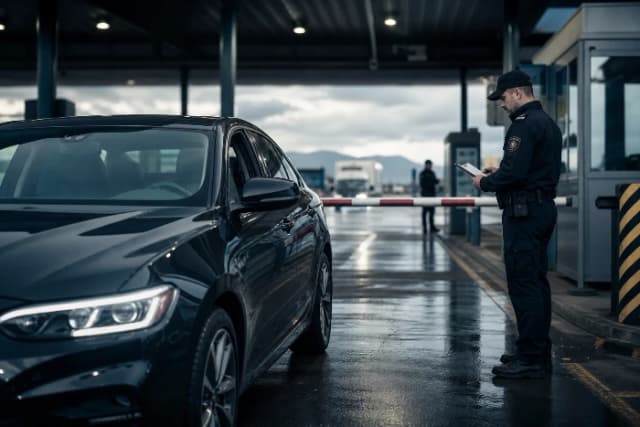
- The vehicle arrives at the border checkpoint.
- The owner or their designated representative submits a transport declaration through the Revenue Service system.
- The customs value is determined, and excise tax and VAT are calculated.
- Payment can be made at a bank or via the Revenue Service online portal.
All technical documentation must be prepared before customs clearance, including details such as model, manufacturing year, color, engine numbers, and country of origin. Missing or conflicting documents will freeze the process, leading to daily storage charges.
Registration: The Final Essential Step
After customs clearance, the motorcycle must be registered at the Service Agency of the Ministry of Internal Affairs (MIA). The procedure mirrors car registration: technical inspection, drawing up an inspection report, submitting the customs declaration, and issuing the registration certificate. The registration certificate is issued once all preliminary steps are complete.
Riding a motorcycle in Georgia requires a Category A driver’s license, which is categorized by engine output and displacement:
- A1: Up to 125 cc, maximum power of 11 kW.
- A2: Maximum power of 35 kW.
- A: Any displacement and power.
Common Mistakes That Increase Import Costs
- Budgeting based only on the bid price: On top of the winning bid, you must budget for the Buyer’s Premium, storage, Gate Fee, U.S. inland transport, ocean shipping, customs clearance, VAT, and registration fees. Final costs are typically 40–60% higher than the initial bid.
- Ignoring vehicle age: From 2026 onward, clearing a motorcycle older than 6 years costs three times as much. A model that looks like a bargain can become surprisingly expensive due to age-based excise taxes.
- Skipping the VIN check: Title Washing can conceal a Salvage history behind a Clean Title label. This hidden history will only come to light during repairs or resale when it is too late.
- Judging condition solely from photos: Frame alignment, electrical integrity, and internal engine health cannot be fully evaluated through photos alone. U.S. auction lots always require professional technical evaluation, especially in flood-damage cases.
- Delaying document preparation: All technical paperwork must be ready prior to clearance. Any missing or inconsistent details delay clearance, accumulating storage charges for every extra day.
Importing a motorcycle from the U.S. or Japan is a step-by-step process combining technical evaluation, customs procedures, and logistics. Title status, VIN history, photo inspection, transit timelines, age and engine capacity excise calculations, customs clearance, and registration all determine the final price tag. Leaving out even one variable changes the equation.
The Carmark team manages this entire process from initial selection to delivery in Georgia. All import expenses—including Buyer’s Premium, customs clearance, and logistical fees—are calculated upfront before purchasing. This ensures complete transparency before you make any commitment.
Related Posts


Your dream car journey starts with our expertise

Popular pages
Explore
Recourses